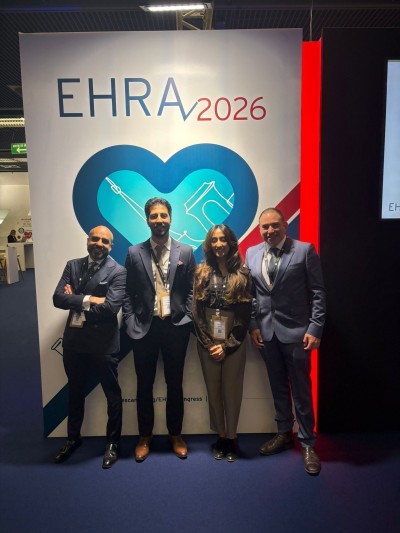

Resident doctors Pharveen Jaspal and Alend Abdullah, alongside Consultant Cardiologists Roger Beadle, and Shoaib Siddiqui, recently showcased their work on an international stage by delivering oral presentations at the European Heart Rhythm Association (EHRA) Congress in Paris. This achievement reflects the high quality and clinical relevance of their contributions.
Dr Jaspal presented a complex and thought-provoking case titled “Recurrent syncope in a young patient: vasovagal and psychogenic pseudo syncope emerging as the leading explanation amid pacing, device infection, extraction, and cardioneuroablation.” Her work explored the diagnostic challenges of recurrent syncope, highlighting the importance of careful evaluation in distinguishing between physiological and psychogenic causes, even in the context of advanced cardiac interventions.
Dr Abdullah’s presentation, “Anaesthetic-induced ventricular fibrillation in a female Duchenne Muscular Dystrophy carrier: recognising cardiac risk,” focused on an important yet under-recognised clinical risk. His case emphasised the need for heightened awareness of cardiac complications in carriers of Duchenne Muscular Dystrophy, particularly in perioperative settings.
Dr Beadle presented “Device troubleshooting: Inappropriate device therapy in diabetic ketoacidosis,” addressing a critical issue in cardiac device management. His work highlighted how metabolic disturbances such as diabetic ketoacidosis can lead to inappropriate device therapies, underlining the need for careful interpretation and management in complex clinical scenarios.
Dr Shoaib Siddiqui, Consultant Cardiologist, acted as supervising author for the submissions by Dr Jaspal and Dr Abdullah and was co-author for Dr Beadle’s work. Dr Siddiqui, who has a strong interest in supporting the development of resident doctors, played a key role in guiding these projects. Dr Beadle, who leads the cardiac device service at SWFT, was also a co-author on the resident doctors’ submissions.
Their participation at EHRA demonstrates that the role of clinicians at SWFT extends beyond day to day patient care, contributing to international cardiology practice, education, and research. It also reflects a strong commitment to mentoring and supporting resident doctors, recognising them as the consultants of the future and investing in their development on a global platform.